
The Wedding Planning Checklist, Month by Month (12 Months to the Day)
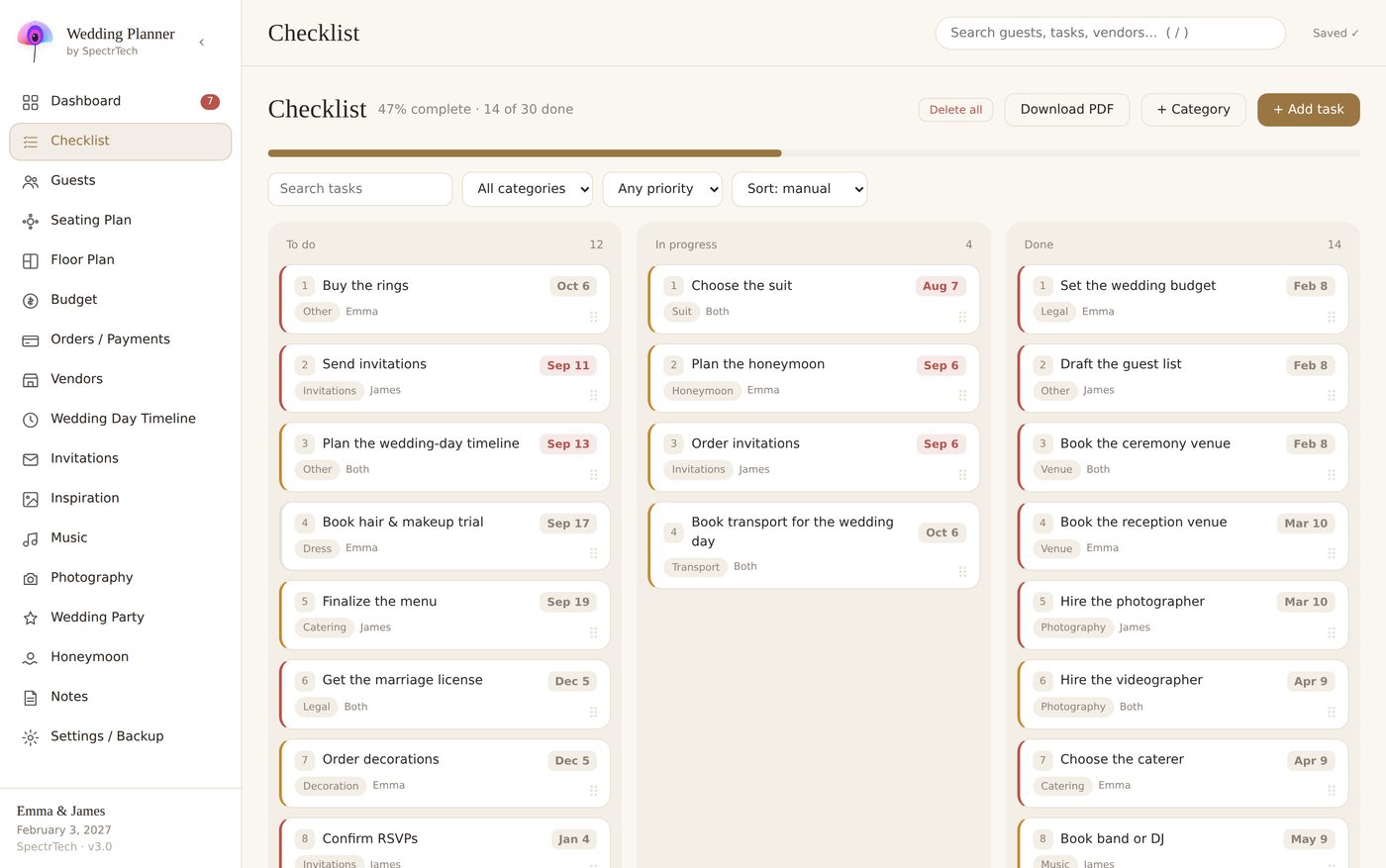
Most wedding checklists are 200 items long and useless by week two. This one is built the other way round: only the decisions that block other decisions, ordered by when they actually have to happen. It is the same 30-task list that ships inside our planner, expanded with the reasoning behind each step.
Two rules before you start. First, the order matters more than the dates — if you have eight months instead of twelve, compress the early phases, not the last month. Second, three things are “gates”: guest count, budget ceiling and venue. Almost everything else depends on them, so settle those before you look at a single invitation design.
12 months out: the three gates
- Agree the budget ceiling. Not a wish, a ceiling: the number you will not cross. Decide who contributes what, in writing, before anyone books anything.
- Draft the guest count. A rough list is enough — but the count drives the venue size, catering cost and stationery. Every later decision is priced per head.
- Pick a date range, not a date. Two or three windows give you leverage with venues; a fixed date turns every conversation into “it's booked”.
- Shortlist venues. Visit the top three. Ask for the room dimensions and the maximum seated capacity — you'll need both for the floor plan later.
9 months out: book what can only be booked once
Photographers, venues and good caterers are booked by the date, and popular dates go a year ahead. Everything in this block is “one per wedding day”, so it comes before anything that can be bought any time.
- Book the venue (ceremony and reception, if separate). Get the contract, the deposit schedule and the cancellation terms in writing.
- Book the photographer and, if you want one, the videographer.
- Book the caterer or confirm the venue's in-house catering, with a per-head estimate.
- Choose the wedding party and ask them — they need the date in their calendars too.
- Start the dress and suit search. Made-to-measure and alterations take months, not weeks.
6 months out: the things with lead times
- Order or design invitations. Printing plus postage plus RSVP time means invitations should be in hand by month four.
- Book the DJ or band, florist and cake.
- Book accommodation blocks for out-of-town guests.
- Plan the ceremony: officiant, readings, music.
- Register for gifts if you're doing a registry.
- Start the honeymoon plan — passports, visas and peak-season bookings have their own lead times.
3 months out: send, confirm, finalise
- Send invitations with an RSVP deadline about five weeks before the wedding. Track replies as they arrive, not in a batch at the end.
- Finalise the menu and any dietary options. Your guest list needs a “meal” column now.
- Buy rings, shoes and accessories; schedule fittings.
- Write the first draft of the wedding day timeline and share it with the photographer and venue — they will tell you where it breaks.
- Confirm transport for the couple and, if needed, for guests.
1 month out: the seating chart month
This is where most of the stress lives, so give it a whole month and do it in this order:
- Chase every missing RSVP. Two reminders, then a phone call.
- Give the caterer the final headcount and meal counts (usually due 10–14 days out).
- Build the seating chart from the confirmed list. Tag family groups first, then the pairs who should not sit together, and only then start placing people. If you use our planner, Auto Arrange does that first pass for you from the tags.
- Pay the final vendor balances that are due before the day, and write down what is still due on the day and in what form.
- Do the final dress fitting and pick up the suit.
The final week
- Send the wedding day timeline to every vendor, the wedding party and both families.
- Send the seating chart and floor plan to the venue.
- Pack the emergency kit: sewing kit, stain remover, painkillers, phone chargers, a printed timeline and a printed seating chart.
- Confirm arrival times with every vendor by phone.
- Hand the “must play / do not play” list to the DJ.
- Assign one person (not you) to hold the vendor payments and tips on the day.
The three wedding planning tasks couples do too late
The seating chart. Started the week before, it takes a whole week. Started a month before, with a tagged guest list, it takes an afternoon.
The timeline. A timeline written the night before is a list of hopes. Written at three months and revised at one month, it catches overlaps — hair and makeup running into the first look, or an hour gap between the ceremony and the reception with nothing planned for guests.
The backup of your own data. If your plan lives in an app, find out today how you would get it out. If it lives in a spreadsheet, make a copy that isn't on one laptop.
Want it on paper? Get the free printable 12-month checklist (PDF, 6 pages) — the same order as this guide, with tick boxes and a vendor contacts page.
Wedding Planner by SpectrTech — one offline HTML file, 17 connected sections, 9 languages. No account, no subscription. $24.99 one-time.
See the planner on Gumroad
A note on adapting the timeline
If you have less than a year: keep the order, halve every phase, and accept that the “only once” bookings (venue, photographer, caterer) will be chosen from whoever is free rather than from a shortlist. If you have more than a year: don't start earlier — start at 12 months and enjoy the extra time. Trends, prices and even your guest list change; decisions made two years out get remade anyway.